Last updated: October 13, 2026
Key Takeaways
- Good for surface rewrites, not meaning changes.
- Bad paraphrases often sound polished and still drift.
- Treat the tool as an assistant, not the decision-maker.
- AI can help with academic prose, but not with disguising source text.
A paragraph can look clean and still go sideways. That is the real risk here. If you need to restate someone else’s wording without changing the meaning, AI paraphrasing tools can save time — but only for low-risk, clearly understood text. In this article on AI writing tools for paraphrasing: when they help and when they fail, the safest use case is usually a rough draft, not a final version.
Quick answer: AI paraphrasing tools are best for low-stakes rewrites, and they still need human review in every case where meaning matters. Legal, medical, technical, or citation-sensitive text should be checked by a professional before you trust the rewrite.
In short: use them for rough drafts, tone shifts, and plain-language rewrites; avoid them for legal language, technical definitions, academic source use, and anything where changing one word changes the claim.
AI paraphrasing tools look simple on the surface. Paste in a paragraph, click a button, get fresh wording back. Yet paraphrasing is not the same as rewriting. A tool can swap sentence structure and still quietly distort the meaning, flatten the tone, or introduce a claim that was never there.
So the real question is not “Which paraphrasing tool is best?” It is “What kind of text am I changing, and how much damage can I tolerate if the tool gets it wrong?” Very little? Then human control has to stay in the loop from the first draft to the final line. For practical guidance on paraphrasing and attribution, see the Purdue OWL’s paraphrasing advice and APA Style’s guidance on source use.
What AI paraphrasing tools are actually good at
AI paraphrasing tools are useful when the goal is to change surface form, not substance. If you already know what you want to say and you just need cleaner wording, a model like ChatGPT, Claude, or QuillBot can get you unstuck in 2 minutes instead of 20.
That works best for:
- shortening a rambling paragraph
- changing tone from stiff to plainspoken
- making repeated wording less repetitive
- turning notes into a first-pass draft
- adapting a sentence for a different reading level
A bloated 300-word internal memo is a good candidate. An AI rewrite can turn that into a workable starting point. But hand it a dense policy statement and ask for “the same thing, just better,” and the tool may delete the legal caution you needed or soften a warning into mush. That math stops working fast. In a 2023 Stanford HAI analysis of language models, even strong systems still showed reliability gaps on tasks that required precision rather than fluency.
A practical path looks like this:
- Decide the job: clarity, brevity, tone, or originality.
- Mark the words that cannot change: names, dates, figures, legal terms, product specs.
- Paste only the passage that needs help, not the whole document.
- Tell the tool what to preserve: “Keep the meaning and the warning intact.”
- Compare the rewrite line by line against the original.
- Manually restore anything that got blurred, deleted, or overgeneralized.
Tools like QuillBot, Wordtune, Grammarly’s rewrite features, and ChatGPT can be decent assistants here. They are not replacements for judgment. They move fastest when the source text is already accurate and the job is mostly cosmetic.
Quick check: if your paragraph is already correct and only sounds clumsy, an AI paraphraser may help; if the wording carries legal, technical, or factual weight, it needs human review. Consult a professional when the text governs a decision or obligation.
When AI paraphrasing tools fail, the failure is usually invisible
AI paraphrasing tools fail most often by sounding confident while quietly changing the meaning. That is the dangerous part, because a bad rewrite can look polished enough to skip a second read.
The classic failure modes are easy to miss:
- Meaning drift: “may” becomes “will,” or “can” becomes “does.”
- Tone inversion: cautious language turns into overclaim.
- Loss of specificity: “three-month pilot” becomes “short trial.”
- Source damage: a quote or citation gets rewritten so heavily it is no longer a quote.
- Concept collapse: two distinct ideas get blended into one vague sentence.
This matters most in fields where exact wording carries consequences. A healthcare summary, a contract clause, a compliance note, or a research abstract all punish sloppy paraphrase. A tool like ChatGPT or Gemini can still produce a tidy sentence, but tidy is not the same as faithful. The WHO notes that medication or treatment errors can arise from communication problems, which is exactly why “close enough” is not enough in clinical text.
Here is the rule I would use: if a sentence would change someone’s decision, paraphrase it manually. If a sentence only changes style, a tool can help.
| Situation | Best Path | Why Other Options Fail |
|---|---|---|
| Blog intro that feels repetitive | Use an AI rewrite, then edit for voice | Manual rewriting takes longer; raw AI can sound generic |
| Product copy with one clear claim | Use AI only on non-claim sections | A tool may overstate performance |
| Legal wording | Rewrite manually or with counsel review | AI can alter obligation, exception, or liability language |
| Academic source material | Use AI only to brainstorm, not to paraphrase cited text | It can blur what the source actually said |
| Internal notes | Use AI for clarity and compression | Risk is lower, but meaning still needs a check |
If you are paraphrasing anything that must stay exact, then the best use of AI is to produce options you reject, not final copy you trust blindly. The FTC also warns that misleading claims can create serious problems, so the safest workflow is always conservative when accuracy matters.
Quick check: if a single wrong synonym could change a promise, instruction, or claim, AI paraphrasing is too risky unless you inspect every line. If the sentence belongs in a contract, chart, or regulated disclosure, consult a professional.
How to use AI paraphrasing tools without getting burned
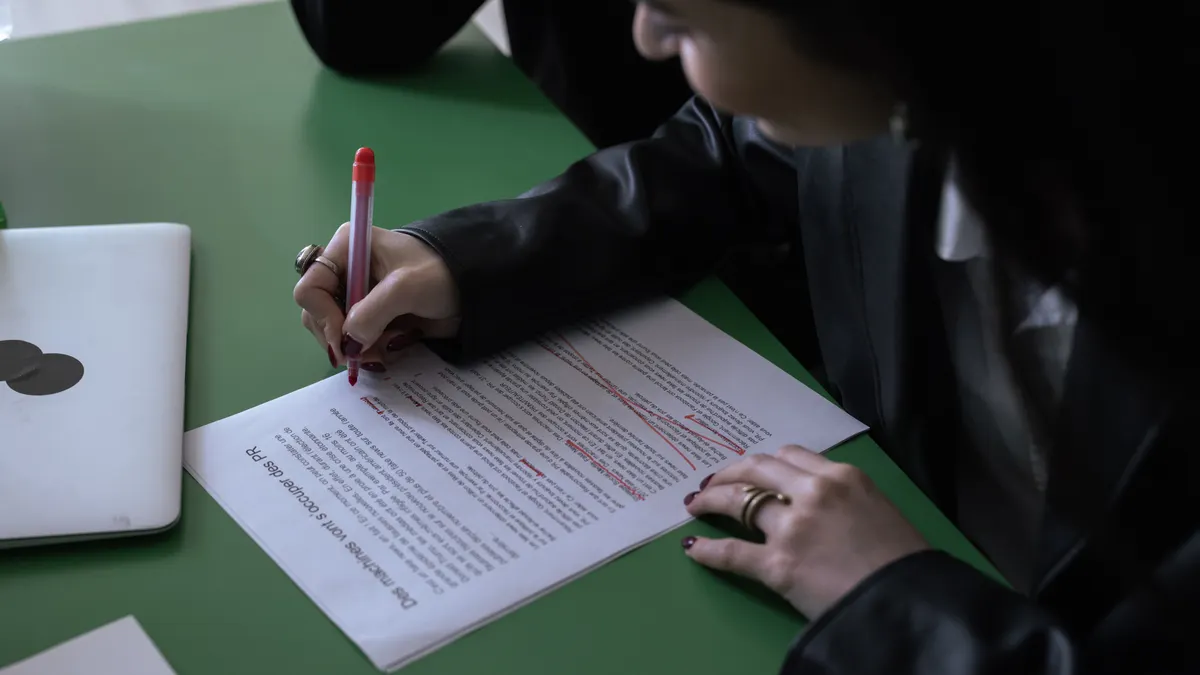
AI paraphrasing tools work best when you treat them like a junior assistant with a sharp pencil and no authority. They can draft; they should not decide.
Start with the sentence you want to preserve, then give the tool a narrow brief. “Rewrite for plain English, keep the exact meaning, do not add claims, keep technical terms unchanged” works much better than “paraphrase this.” A vague prompt invites the model to improvise.
The safest workflow is often to split long text into one idea per paragraph, because that makes review easier and keeps changes local.
- Split long text into one idea per paragraph.
- Protect exact items first: numbers, legal phrases, brand names, product names, dates.
- Ask for one of three changes only: shorter, clearer, or more natural.
- Review the output against the source sentence by sentence.
- Check whether the rewrite changed modality words such as may, might, should, and must.
- Read the paraphrase out loud to catch awkward rhythm or accidental emphasis.
- Do a final pass for facts, citations, and quoted language.
If you are using ChatGPT, Claude, Jasper, or QuillBot, the same rule applies: prompt quality matters, but review matters more. Better prompting reduces cleanup. It does not remove the need for it. OpenAI’s own guidance on prompting emphasizes specificity for better results, which is useful here because narrow prompts reduce unwanted drift.
I would also keep one hard boundary: never let a tool paraphrase source quotes you plan to cite as quotations. If the source must remain a quote, keep it exact. If you want to summarize it, stop calling it a quote.
That distinction sounds basic, but it is where a lot of problems begin. Many readers do not need “new words.” They need a shorter, cleaner version of the same thought. That is a summary task, not a paraphrase task.
Quick check: if your workflow ends with “paste it and publish it,” it is too loose; if it ends with line-by-line comparison, you are using the tool correctly.
Can AI paraphrase academic writing or source text?
AI can help you rewrite academic-style prose, but it should not be used to disguise copied source material. That line matters.
If you are working on notes, a literature review draft, or your own rough explanation of a concept, AI can help you make the language less clunky. If you are trying to restate a source paragraph so closely that the structure is still the source’s, the tool can push you into patchwriting territory, which is risky even when the words are not identical.
The safer path for academic work is:
- read the source
- close it
- write the idea from memory in your own words
- compare for accuracy
- cite the source clearly
For standards around paraphrasing and attribution, APA Style guidance and the MLA Handbook both stress that paraphrases still need proper citation and real transformation, not surface-level word swapping. The Purdue OWL also has practical guidance on paraphrasing and avoiding patchwriting.
A useful test is this: if you cannot paraphrase the idea without following the source sentence structure, you do not understand it well enough yet. The fix is not another AI rewrite. Reread the source and restate it from the concept level.
There is one exception. If you are translating dense academic prose into plain English for a general audience, AI can be helpful as a first draft. In that case, you are not protecting scholarly style; you are reducing jargon. But if a term has a specific disciplinary meaning — say “statistically significant,” “randomized controlled trial,” or “scope of practice” — do not let the tool smooth it away.
Quick check: if the text will be graded, published, or cited, AI may help you clarify your own explanation, but it should not be the thing that “rephrases” the source text for you. When in doubt, consult a professor, editor, or librarian who can check attribution rules.
What changes when the text is legal, medical, or technical?
The answer changes completely: AI paraphrasing is low-risk for plain-language help and high-risk for wording that carries formal meaning.
If you are dealing with a contract clause, a medical note, a safety procedure, an engineering spec, or a finance disclosure, then paraphrasing can break the text even when it looks cleaner. A single modal verb or defined term can carry a lot of weight. For example, replacing “must” with “should” softens an instruction; replacing a defined term with a synonym can create ambiguity the original avoided.
That does not mean AI has no role. It means the role is narrow. I would use it to:
- simplify explanations for non-experts
- create a plain-English companion version
- generate a checklist from approved source language
- help a writer ask better questions before editing
I would not use it to rewrite the actual governing text.
A careful workflow here looks like this:
- Identify the sentence type: instruction, warning, definition, obligation, or description.
- Freeze all defined terms, numbers, thresholds, units, and dates.
- Ask for plain-language explanation, not substitution.
- Compare the rewrite against the source for legal or technical meaning.
- Send anything consequential to the subject-matter expert, attorney, clinician, or engineer responsible for it.
There is no magic setting that makes a model safe for regulated language. Even a strong model can miss context that matters in a statute, a treatment note, or a spec sheet. If the text controls behavior, paraphrase is not the right first move, and legal or clinical review should come before publication.
Quick check: if someone could rely on the sentence in court, in a clinic, or on a worksite, AI should only help explain it, not replace it.
The edge cases where normal advice breaks down
AI paraphrasing tools need special handling in a few situations because the usual “rewrite and review” advice is not enough.
- You are paraphrasing your own old writing from 2 years ago. Meaning: plagiarism risk is lower, but your habits may still be stale. What to do instead: use the tool only to break repetitive phrasing, then refresh the logic yourself.
- You need the same idea in 5 versions for A/B testing. Meaning: consistency matters less than controlled variation. What to do instead: ask for distinct tones or structures, then keep the claim set identical across versions.
- You are working with quotes, slogans, or brand lines. Meaning: exact wording is part of the asset. What to do instead: do not paraphrase the line itself; write surrounding copy instead.
- You are summarizing user-generated text or a customer complaint. Meaning: emotional tone and nuance matter. What to do instead: preserve the user’s intent and any factual complaint, and never “clean up” a quote so much that it changes the complaint.
- You are paraphrasing for a second language audience. Meaning: clarity matters more than elegance. What to do instead: favor short sentences, common verbs, and explicit nouns; avoid idioms the tool may mis-handle.
- You are handling sensitive content like harassment reports or incident logs. Meaning: exact wording can matter for evidence. What to do instead: retain the original record and create a separate plain-language summary.
These are the places generic advice fails because “better wording” is not the real goal. The real goal might be accuracy, defensibility, comparability, or emotional fidelity. A 2024 IEEE discussion of AI-generated text risk noted that fluent output can still conceal small but important changes, which is why edge cases need extra care.
Quick check: if the text has evidentiary, brand, or audience-specific weight, paraphrasing is a special case, not a routine edit.
How I would choose between AI and manual paraphrasing
I would choose AI when speed and readability matter more than perfect control, and I would choose manual rewriting when meaning, nuance, or accountability matter most.
That gives a clean decision rule:
- If the text is informal, internal, or already low-stakes, AI can do the first pass.
- If the text is published, regulated, cited, or persuasive, manual editing has to own the final version.
- If you cannot explain the original sentence in one clear sentence, do not let the tool rewrite it yet.
A good paraphrase should preserve the original claim, audience, and tone while changing the wording enough that it is genuinely new. Lose any one of those, and it failed. Change all three, and it failed louder.
The tools themselves are not equal in every job, either. QuillBot is built around rewriting modes. Grammarly is better at polishing. ChatGPT and Claude are more flexible, which also means they are more likely to wander if your prompt is vague. A tool that offers many options is not automatically safer than one that offers fewer.
My own rule is simple: the more exact the message has to be, the less I trust a paraphraser to finish the job alone. This is why AI writing tools for paraphrasing: when they help and when they fail should always be judged against the job, not the hype. When precision comes first, consult a professional or a subject-matter editor.
Quick check: if you need elegance more than precision, AI is useful; if you need precision more than elegance, treat AI as a draft aid only.
Drafted with AI; not yet reviewed by a person.